Courtney Calls on Congress to Reclaim War Powers Authority and End President Trump’s War in Iran
WASHINGTON, DC – Today, in a speech on the House floor, Congressman Joe Courtney (CT-02), Ranking Member of the House Seapower and Projection Forces Subcommittee, called on Congress to pass the bipartisan War Powers Resolution H.Con.Res. 40 to end President Trump’s war in Iran.
This week, for the second time since the President launched the war in Iran, the House will vote on a War Powers Resolution to reclaim its constitutional authority over the decision to go to war. On March 5th, Courtney voted to pass War Powers Resolution H.Con.Res 38, which narrowly failed to pass by a vote of 212-219.
“Congress cannot wait any longer to act, and I implore my colleagues to support this bipartisan resolution when it comes to the floor this week,” Courtney said.
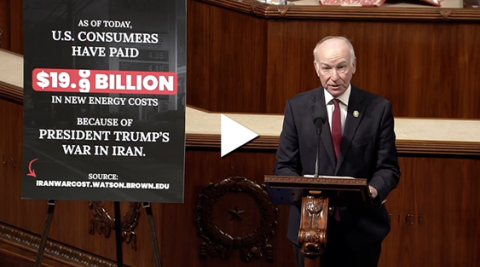
To watch and download the full floor speech video, click here.
FULL SPEECH TRANSCRIPT
Mr. Speaker, this week Congress will have an opportunity to assert its constitutional role when we vote for the second time on a War Powers Act resolution to force President Trump to seek legal authority for his unilateral military campaign in Iran.
As a Member of the Armed Services Committee and a cosponsor of this measure, I strongly urge my colleagues in the House to vote “yes” to reclaim our constitutional role under Article I, Section 8, as the sole branch of government with the power to decide whether our country goes to war.
On February 28th, the President, without consultation with Congress and almost all of our longtime allies, ordered military strikes against Iran, taking the United States into a war now in its seventh week.
Despite the massive cost of this war and the international energy crisis it has created, to date, the President has never articulated what exactly was the “imminent threat” to the homeland on that date. Nor, as he laid out, a clear, practical plan for success.
Mr. Speaker, over the last seven weeks, the most arduous and heart wrenching cost of this war has been borne by 13 American soldiers who lost their lives, and their families. Hundreds of servicemembers have been injured, and hundreds of innocent civilians, some of the very victims of Iran's brutal regime that President Trump said he would liberate, have been killed.
As a result of this war, our servicemembers have had their deployments in the Middle East abnormally extended, such as the sailors on the USS Gerald Ford, which today is on day 294 with no end in sight, and thousands of Marines waiting for weeks in the Middle East aboard amphibious ships as plans for the Strait of Hormuz keep changing.
At home, the war has driven up inflation driven down the stock market, raised interest rates, and sharply driven up energy prices. President Trump ignored U.S. military advice that Iran would close the Strait of Hormuz, where 20% of the world's oil and 30% of its fertilizer transits.
Mr. Speaker, researchers at Brown University a few days ago released a real-time running Iran war cost tracker that calculates the increased cost of gasoline and diesel fuel since February. As of this morning, American consumers have paid $19.9 billion in added costs. And if you go to the website, which is on the poster here, you can watch in real time as the meter runs.
The average price of gas at the war start was $2.98 [per gallon]. Today it is $4.12 [per gallon]. Diesel was $3.67 and today it is $5.65. This morning in my District, on the way to the airport in Enfield, Connecticut, gas is $4.29 and diesel is a staggering $6.19.
Any member of this House visiting a farm, like a dairy farm that I visited back home during the Easter break, or a small businesses like home builders that run their equipment on diesel have heard about the shock and hit that they are taking in terms of keeping their operations sustainable and profitable.
The entire world had high hopes that the present two week cease fire would quickly pivot to a longer-term deal and opening of the strait. But after negotiations fell through, the President announced that he was instituting a naval blockade of all Iranian ports with no allied support. Another example that he continues to believe he is free to escalate this war without any obligation to adhere to constitutional norms.
Mr. Speaker, let me be very clear. Every legal authority indicates that under the law of the sea, this is an act of war, and in testimony to the Senate on January 28th Secretary of State and National Security Advisor Marco Rubio himself said, “A blockade is an act of war.”
Mr. Speaker, the one role that the Trump Administration has acknowledged Congress must play is to vote on funding this war. There are reports that a request is coming to us for as much as $200 billion to pay for his initiative.
Let me be clear. This body is not and should not be a rubber stamp that forces the cost onto taxpayers for war decisions which were made outside the law.
228 years ago, James Madison wrote the following, “The Constitution supposes what the history of all government demonstrates that the executive is the branch of power most interested in war and most prone to it. It has accordingly with studied care, vested the question of war in the legislature.”
On March 5th, I joined 211 of my colleagues in voting “yes” on the House War Powers Resolution number 38. This War Powers Resolution failed by a vote of 212 to 219. This week, this body has another chance to show the American people that we are listening to them and are aware of the damage caused by this conflict, and have an opportunity to rein in the unilateral actions of this President that is dangerously weakening and isolating our country.
Congress cannot wait any longer to act, and I implore my colleagues to support this resolution, this bipartisan resolution, when it comes to the floor this week.
###